
How is oil supposed to collapse below $100 when the Strait of Hormuz is effectively closed and Bab el-Mandeb is under attack and selective blockade? Diesel and fertilizer are already becoming more expensive. Yet the market is being invited to celebrate: the war is a “win,” inflation will collapse, bond yields will fall, and growth stocks will launch into another parabolic rally.
Maybe markets will rally. Markets can move on a story long before the physical world delivers a verdict. But a declaration of victory cannot unload a tanker, lower a ship’s insurance premium, repair a pipeline, manufacture fertilizer or restore trust between trading partners. The “winning” story can work for a while precisely because the consequences arrive with a delay.
That delay is where FOMO thrives.
The Federal Reserve can tighten, traders can panic, and then a political announcement can reverse sentiment almost overnight. Oil can fall because traders expect a reopening, anticipate replacement barrels or fear a recession. None of that proves that the supply system is healthy. The real test is less dramatic: Are ships moving? Are insurers willing to cover them? Are diesel, freight and fertilizer costs easing? Are inventories rebuilding? Are deliveries arriving on time?
The geography also requires precision. September 11 reporting described Hormuz as effectively closed, while reporting attacks and selective restrictions around Bab el-Mandeb—not a total closure of that passage to every vessel. That distinction affects rerouting, available pipeline capacity, insurance and which countries bear the greatest cost. It does not make the disruption imaginary. Reuters reporting
Trump says Venezuela will provide oil. Additional supply could help at the margin. It cannot instantly replace every grade of crude, refining configuration, shipping route and commercial relationship caught in the disruption. A new source is not the same thing as a restored system.
The unraveling is larger than oil
Once those relationships begin unwinding, every broken connection pulls on another.
Commercial peace theory begins with a simple idea: countries that make money together have more to lose by fighting. Trade creates customers, suppliers, investments and ordinary people whose livelihoods depend on stability. War does not become impossible, but it becomes more expensive—and a larger constituency has a reason to oppose it.
The strongest version of that restraint is not merely trade between flags on a map. It is a broad middle class of business owners, workers and professionals with real economic stakes. They need predictable rules, solvent customers, functioning markets and peaceful access to suppliers. War can destroy what they spent a lifetime building, so they become a quiet but powerful lobby for stability.
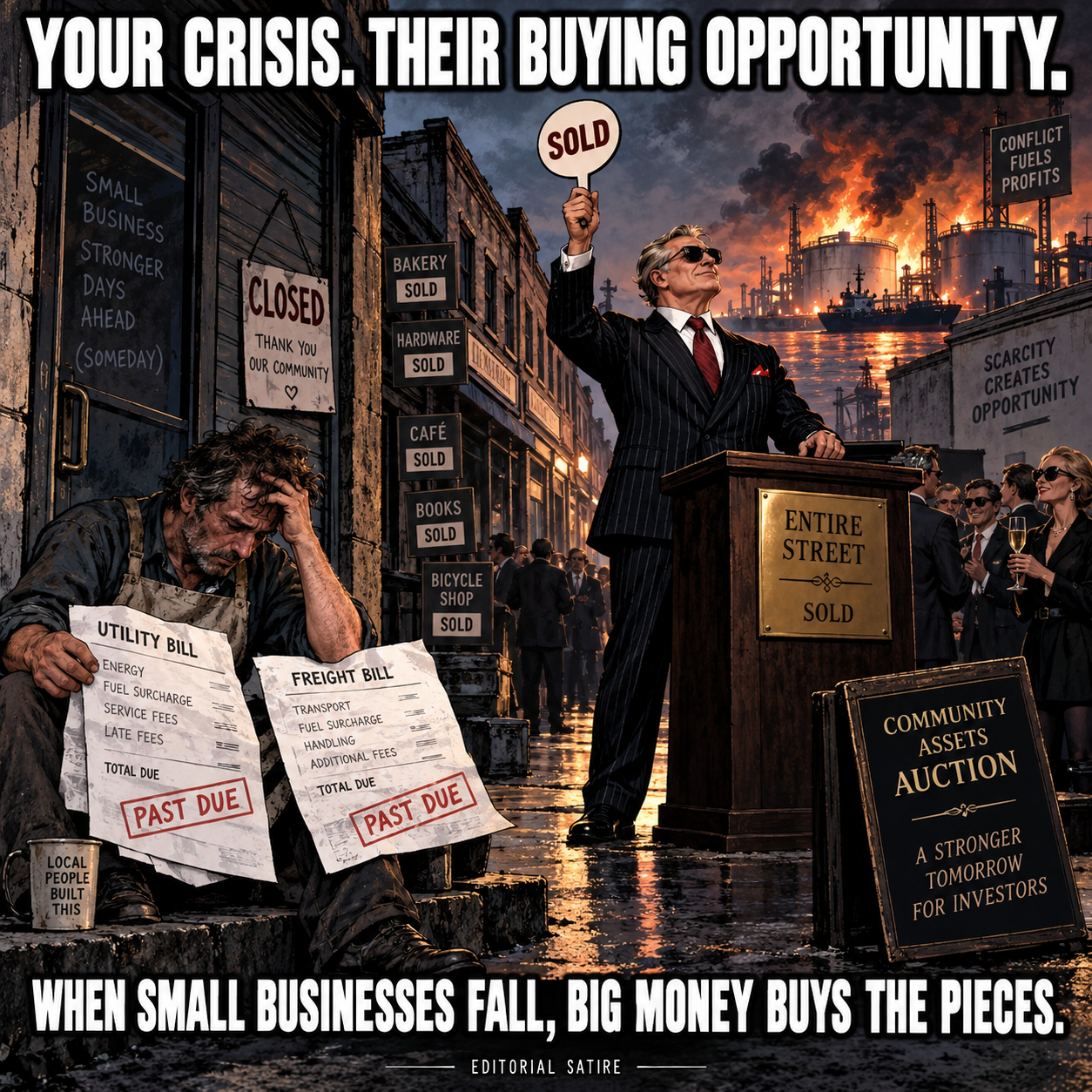
But those incentives change when wealth and commerce concentrate in a handful of elites tied to the state. If independent businesses disappear, fewer people with influence depend on an open and peaceful system. Regime-connected firms may profit from exclusive contracts, protected markets, sanctions workarounds or military spending. Leaders may even find external conflict useful for suppressing dissent or justifying greater control at home.
Trade is therefore not a magic shield against war. Who owns the trade matters.
That is why the destruction of a healthy commercial middle class is not only an economic problem; it can become a security problem. A society with millions of independent stakeholders has millions of reasons to preserve the peace. An oligarchic system can have a very different calculation.
Now imagine the feedback loop across countries. One government fears losing access to an essential input and restricts exports of something its rival needs. The rival retaliates, builds duplicate capacity and signs exclusive agreements with allies. Companies reorganize around the restrictions. Capital follows the new political boundaries. With every step, fewer influential people profit from preserving the old relationship—and more profit from the separation.
This is not a prediction that global war is inevitable. Diversified supply can reduce coercion, and diplomacy can still reverse the cycle. But the danger is real: as commercial ties weaken, the economic cost of escalation can appear smaller to the people making the decisions. IMF research supports the narrower economic warning that fragmented commodity markets can disrupt supply and impose large costs, especially on vulnerable economies. IMF research
Was the squeeze engineered?
It is reasonable to ask who benefits. A squeeze on Middle Eastern energy can pressure China, redirect trade, strengthen favored producers, accelerate domestic infrastructure and enrich owners of scarce capacity. It can also burden Europe, American consumers, farmers, small businesses and the government itself. Military commitments must eventually be paid for through some mixture of taxes, borrowing, inflation or cuts elsewhere.
Those are motives and consequences, not proof of a master plan.
Benefiting from a crisis is not the same as creating it. Exploiting a disruption after it begins is not the same as coordinating every actor who caused it. A single outcome can emerge from Iranian coercion, Houthi ambitions, Israeli strategy, American miscalculation, Russian opportunism and the independent choices of many other governments. History often looks engineered from a distance because competing actors discover ways to profit from the same disaster.
The more defensible accusation is not that one hidden hand controls everything. It is that leaders can choose policies without respecting how tightly the system is connected. A president can sell the first visible outcome as a victory while pushing the costs into the future. The physical consequences arrive after the speech, after the social-media post and sometimes after the trade.
That is not strategy. It is a wager that the narrative will outrun the invoices.
AI makes energy scarcity more consequential
Artificial intelligence is often discussed as though it lives in the cloud. In reality it lives in semiconductor fabs, data centers, substations, cooling systems, fiber networks and power plants. It depends on a long chain of specialized equipment, minerals, memory, processors, optics, construction crews and reliable electricity.
The IEA projected that global data-center electricity demand could more than double to roughly 945 terawatt-hours by 2030, while emphasizing substantial uncertainty around adoption, efficiency and infrastructure. That is a forecast, not destiny, but it reveals the scale of the contest. IEA analysis
At the same moment that trade is fragmenting, governments and corporations are racing to build better models, larger computing clusters and more secure domestic supply chains. Energy is no longer just another input. It is becoming part of the strategic contest over intelligence, industry and military power.
An oil shock does not translate mechanically into an identical electricity shock. Data centers consume electricity, not barrels of crude. The effect travels indirectly through natural gas and LNG, freight, construction, backup generation, interest rates and the cost of nearly everything required to build new capacity. A hydro-powered facility and a gas-dependent grid will not experience the same pressure.
Still, the broad squeeze is clear. Demand for computing and electricity can rise faster than grids, generation and equipment can be delivered. Governments may duplicate infrastructure to reduce dependence on rivals. Redundancy makes a system more resilient, but it is expensive. Somebody must finance it.
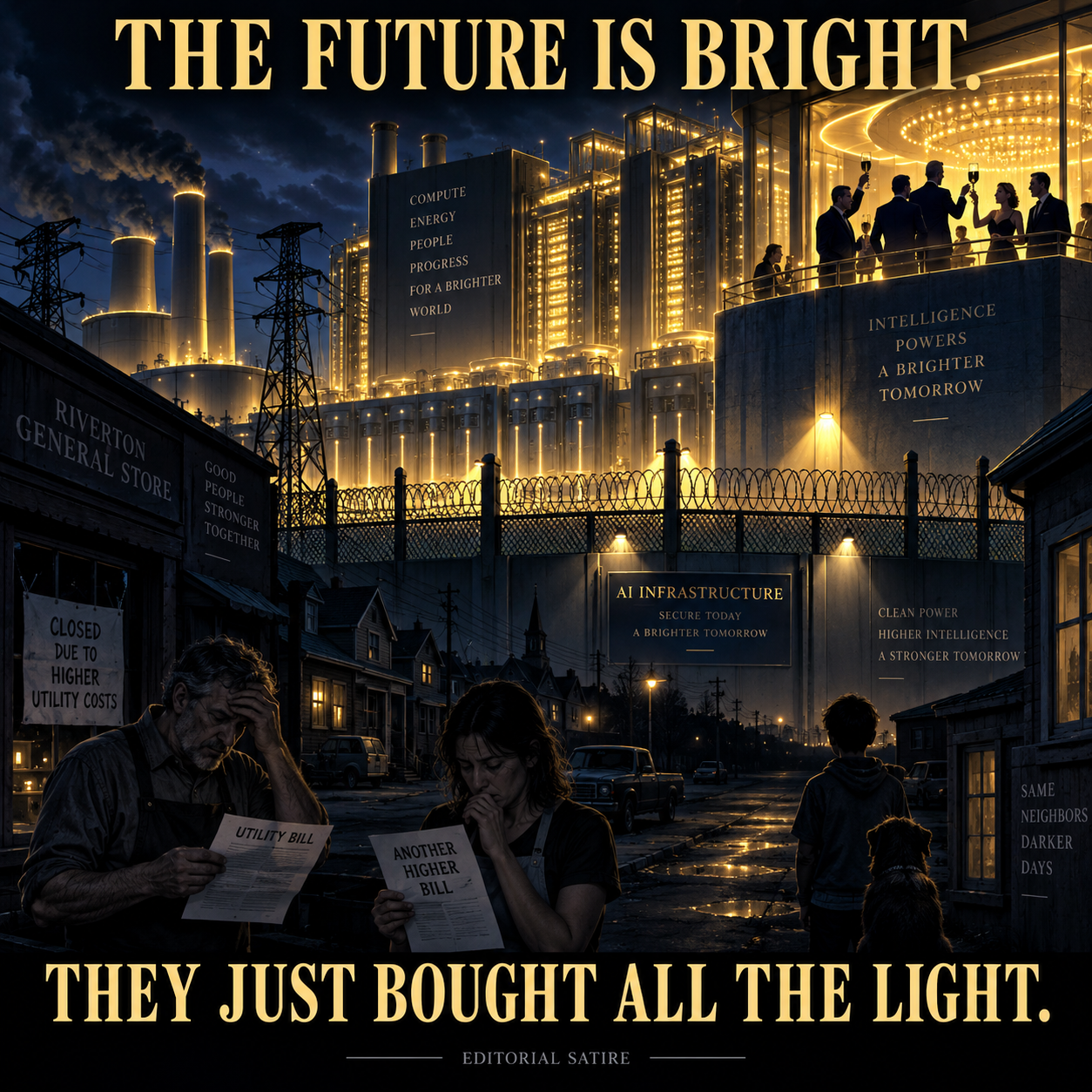
Large firms can lock in power contracts, carry inventory, absorb delays and buy distressed competitors. Smaller firms pay spot prices, face tighter credit and serve customers who cannot absorb another increase. Scarcity therefore does more than raise prices. It can concentrate ownership.
That is the darker possibility behind an AI boom: extraordinary technological progress paired with a shrinking circle of people able to own the infrastructure. Stock indexes could rise while households lose purchasing power and independent businesses disappear. A country might become more technologically powerful while becoming less broadly prosperous—and, by hollowing out its stabilizing commercial middle, potentially less peaceful.
Why this is not automatically bullish for growth stocks
The market may correctly identify the industries the world will need and still misprice the companies building them.
Higher energy, materials and financing costs are especially dangerous for businesses whose profits lie years in the future. Rising rates reduce the present value of distant earnings. Capital-intensive companies must keep funding equipment and construction before revenue arrives. Customers may delay projects. Equity issuance can keep a promising company alive while quietly diluting the owners already there.
Profitable growth companies generally have more room to maneuver, but “profitable” is only the first filter. Accounting earnings are not free cash flow. Adjusted EBITDA can exclude costs that are economically unavoidable. Backlog is not cash. A superb company can still be a poor investment if the stock price already assumes flawless execution.
The opposite is also true: an unprofitable company is not automatically doomed. Cash, debt, contractual obligations, burn rate and access to financing determine whether it has time to reach the next milestone. The useful divide is not simply profitable versus unprofitable. It is self-financing or credibly financeable versus dependent on increasingly expensive capital with no durable economics in sight.
That distinction matters across the names we have been discussing:
| Part of the buildout | Companies | Central question |
|---|---|---|
| Chips, networking and semiconductor equipment | NVIDIA (NVDA), Broadcom (AVGO), ASML, Applied Materials (AMAT), Lam Research (LRCX), KLA (KLAC) | Can margins and orders hold if customers become more selective? |
| Memory, servers and optical links | Micron (MU), Sandisk (SNDK), Dell (DELL), Coherent (COHR), Lumentum (LITE) | How exposed are earnings to cycles, inventory and customer concentration? |
| AI clouds and data-center developers | CoreWeave (CRWV), Nebius (NBIS), IREN, Applied Digital (APLD) | Who owns the equipment, power and leases—and who carries the financing risk? |
| Enterprise technology | IBM | Can recurring cash generation fund investment without sacrificing discipline? |
| Earth observation and space infrastructure | Planet Labs (PL), Rocket Lab (RKLB), SpaceX | Will technical milestones and contracts become durable shareholder returns? |
| Quantum computing and sensing | Infleqtion (INFQ) | Is commercialization advancing fast enough relative to cash burn and valuation? |
These are connected businesses, but they are not interchangeable bets. A toolmaker can be paid before its customer earns a return on the new factory. A chip supplier can thrive while a leveraged cloud operator struggles. Yet suppliers are not immune: if customers can no longer finance expansion, orders eventually weaken.
Owning every layer of the same buildout can feel diversified while actually multiplying exposure to one capital-spending cycle.
Rocket Lab shows why the usual labels can mislead. Its second-quarter report combined national-security contracts and progress toward Neutron with a quarterly net loss of roughly $49 million. It also reported about $2.39 billion in cash and marketable securities at June 30, much of that strengthened by roughly $1.53 billion in first-half at-the-market equity proceeds before issuance costs. It had runway—but shareholders paid for some of that runway through dilution. Rocket Lab results
SpaceX combines mature launch and satellite services with far more speculative ambitions. Its 2026 offering materials describe the acquisition of xAI, the proposed ticker SPCX and orbital computing plans. Established launch economics should not be confused with proof that data centers in orbit will operate economically at scale. The combined enterprise must be judged through capital requirements, governance, consolidated cash flow and valuation. SpaceX SEC-filed offering materials
Infleqtion is earlier still. It reported $12.6 million in second-quarter revenue, a $30.6 million operating loss and $582 million in cash, securities and restricted cash, with no debt. Its reported positive operating cash flow included a temporary payroll-tax timing benefit; excluding that benefit, quarterly operating cash burn was about $14 million. That provides time, not certainty. Quantum sensing and computing may become strategically important without every early investor earning an attractive return. Infleqtion results
A safer thesis for an unsafe world
There is no perfectly safe way to invest in an arms race, an infrastructure boom or a fragmenting global economy. The objective is not to predict every political move. It is to build a thesis that does not collapse if the conspiracy is wrong, diplomacy succeeds, scarcity fades or the market changes its favorite story.
Start with the household, not the ticker. Cash needed for taxes, emergencies, payroll or near-term obligations should not depend on a speculative growth stock recovering on schedule. A core portfolio should be genuinely diversified; several funds that own the same handful of AI leaders are not several independent bets. Diversification reduces concentration risk, but it cannot eliminate market loss. Investor.gov
Then treat each growth position as a claim on future cash, not as a vote for an exciting technology. Ask how much capital the company still needs, when debt matures, whether customers can cancel, how much stock-based compensation and dilution owners are absorbing, and what valuation already assumes. Keep the most speculative positions small enough that being wrong does not alter the rest of your life.
Most importantly, make the thesis survive opposite futures.
If the straits remain disrupted, firms with pricing power, strong balance sheets and control of scarce infrastructure should be better positioned than leveraged imitators—but even they can be overvalued. If trade normalizes quickly, financing-sensitive companies may rally while scarcity premiums disappear. If AI spending slows, backlog quality and customer economics will matter more than press releases. If efficiency and new energy supply improve faster than expected, the winners may be the companies that create abundance rather than those priced for permanent bottlenecks.
Watch the physical evidence: shipping volumes and insurance rates, diesel and LNG prices, fertilizer and freight, regional power contracts, grid connections, equipment lead times, free cash flow, debt refinancing and new shares issued. The market narrative can change in an afternoon. These indicators reveal whether the world underneath it is actually healing.
The bigger picture is not that every disruption was secretly designed to make a few AI and energy investors rich. It is that war, scarcity and concentrated ownership can reinforce one another. Broken trade relationships weaken constituencies for peace. Energy pressure favors those with capital. AI raises the value of the infrastructure they control. Wealth can concentrate further, leaving fewer independent economic actors with the power to demand stability.
That is the chain reaction worth fearing—and interrupting.
The world may indeed need far more computing, semiconductors, power, satellite communications, launch capacity and quantum sensing. Some of the companies building them may become extraordinary investments. But strategic importance is not the same as investment safety, and a rising market is not proof of a healthy peace.
“Winning” is not a headline. It is a result measured in open shipping lanes, falling real costs, functioning markets, a broad class of people able to build wealth—and fewer reasons for nations to fight.
Editorial note: Company figures are dated snapshots, not current valuations or personalized buy/sell recommendations. The analysis distinguishes verified conditions from hypotheses about motive and treats the investment framework as a set of questions, not a forecast.
Human lives count most of all
Beyond shipping lanes, energy prices and stock portfolios is the human cost of war. The reported discrepancies in casualty accounting deserve transparent explanation and an accurate public record, including how deaths are classified across operations.
ABC News reported on July 24 that the Pentagon’s published death toll dropped from 18 to 14; officials attributed the discrepancy to technical problems. The same report says Trump publicly cited 18 deaths. That is not evidence that he literally said the lives “don’t count.” It is reason to insist on a complete, accurate accounting.
Behind every recorded death is a person and a family. A change in an operation’s name or an accounting category does not change that loss. Markets may recover. Supply chains may be rebuilt. People killed in war cannot be brought back.
Human lives count most of all.